

Taking furniture out of Matterport 3D virtual tours is now an option.
This is a great upgrade: the ability to remove furniture (defurbishing) from Matterport 3D virtual tours!
Being able to showcase empty spaces can be helpful in marketing and planning.
How often have you shown a space where the clutter and unwanted furniture obstructed your vision? It can be hard to imagine the potential of a space when it is filled with unnecessary items.
Defurnishing not only saves time and money for the customer but also lets you view the complete picture of the future project, thus eliminating confusion.
This approach is super important in areas like interior design and real estate.
Interior designers view a clear and open space as a blank canvas that inspires creativity and innovation. It enables designers to create spaces that are both visually appealing and practical, matching the client’s vision.
Defurnishing effectively showcases a property’s true value for real estate professionals. A space without excess furniture allows potential buyers to imagine how they would customize and use the area. This method results in faster sales and increased satisfaction for buyers and sellers.
How defurnishing 3D virtual tours works.
Now if you want to understand how this works, I will try to avoid getting too technical and explain it in a way that is easy to understand. Defurnishing is the digital process of removing furniture and other belongings from a room to make it appear empty.
It starts with a Matterport Pro 2 camera that serves to first capture the area. Then the tour is uploaded to the cloud.
The Matterport software begins by identifying the components connected to the furniture and completing the spaces created by the objects being removed. Here is an example of the final result.
Understanding semantic segmentation.
Let’s start by explaining what inpainting is in regards to defurnishing 3D virtual tours.
In the digital world, inpainting uses complex algorithms to fill in missing parts of an image with details that match the surrounding area. For example, inpainting can be used to remove an unwanted object from a photo.
You are probably familiar with apps like Gemini AI from Google and Adobe’s Firefly by now.
People often use inpainting as a method for editing and restoring images. It helps to fill in any missing or damaged parts of an image, making it look whole and natural.
The same way Matterport applies their own inpainting to make sure these sections blend in nicely with the surrounding image, so everything looks consistent and intact.
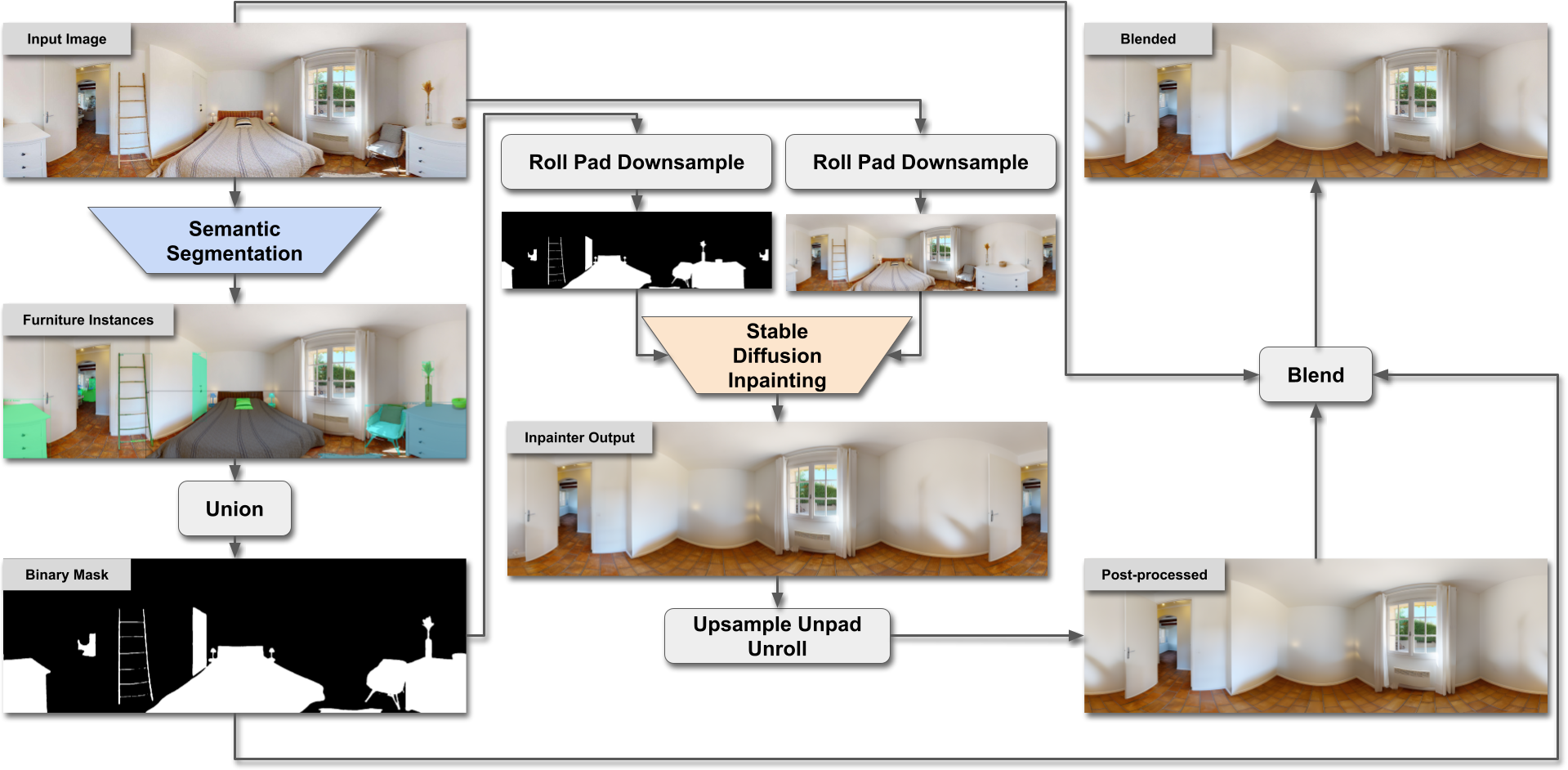
Matterport has some excellent ways to split pictures into different pieces!
They also have a unique method for keeping everything organized.
They use special models called “Vision Transformers” to help them see and understand different parts of things, how they fit together in space, and what they mean.
Ontologies (and I don’t mean it in “the study of being” way, but in meanings of the symbols in an information system) for removing furniture are challenging, especially when distinguishing stand-alone and built-in furnishings.
Matterport has models with data that speak many different words! Know flat, rough shapes to detail.
These models help you find things and ideas without category sorting.
Mixing words and photos in models shows how different places work. Together, these models can make virtual spaces easier to navigate and understand.

Understanding semantic segmentation in defurnishing 3D virtual tours.
The important job of semantic segmentation in computer vision is to organize each pixel into groups like floor, wall, or table. With semantic segmentation, Matterport can find and sort things in a room, which helps to move furniture around and make spaces look empty.
Issues or mistakes in these furniture segmentation masks can really impact how good the inpainting results turn out.
Sometimes, false negatives happen when some actual parts aren’t segmented, which results in furniture remnants appearing in the final output. Other times, instead of just measuring the floor and wall areas, someone might accidentally end up creating a door to a room that’s not even there. Oops!
So, having reliable semantic segmentation is really important for getting great finishing results in defurnishing 3D virtual tours.
The best part? You can easily make precise adjustments, allowing you to change or remove elements without any hassle.
Sometimes, semantic segmentation models can have tricky problems, but with supervised training, they can be a bit easier to handle!
With itourvista3d’s expertise, embrace the advantages of defurnishing and unlock the hidden potential of any space.
1 Comment.
[…] virtually available to anyone, anywhere in the world. Clients found the virtual tours gave them a good feel for the floor plan and flow of the […]